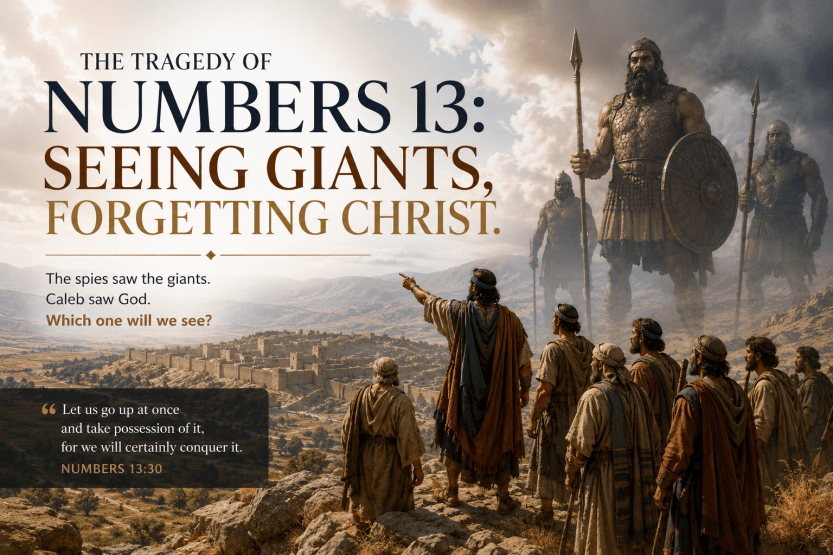
One striking thing about Numbers 13 is that the spies were not lying about what they saw. The cities truly were fortified. The people truly were strong. The descendants of Anak truly were intimidating. The problem was not that the facts were inaccurate. The problem was that their interpretation of the facts was disconnected from the faithfulness and power of God.
God had already brought Israel out of Egypt with mighty signs and wonders. They had seen the Red Sea part before them. They had witnessed Pharaoh’s army destroyed. They had eaten manna from heaven and drank water from the rock. Yet when they encountered a new challenge, many of them evaluated the situation as though God’s past faithfulness carried no relevance to their present circumstance.
That is often the condition of the human heart, even among Christians today.
We easily remember the size of the obstacle more than the greatness of the God who has carried us repeatedly. We react to visible realities while forgetting invisible truths. We become overwhelmed by the “walled cities” before us: financial pressure, uncertainty, opposition, delay, failure, sickness, closed doors, hostile environments, or intimidating systems. Like the spies, we begin to speak according to appearances rather than according to God’s nature and promises.
What is especially sobering is how the spies described themselves: “We were like grasshoppers in our own sight.” Before the enemy reduced them, they had already reduced themselves internally. Fear distorted their identity. They forgot they were a covenant people carried by God Himself. Their inward perspective became smaller than the God who delivered them.
This is what unbelief often does. It shrinks a person inwardly before any external battle is even fought.
Caleb, however, saw the same land through a completely different lens. He did not deny the reality of the challenge. He simply placed God above it. His confidence was not rooted in Israel’s military strength, experience, or numbers. His perspective was singular: if God is with us, then the outcome is already settled.
“Let us go up at once and take possession of it; for we will certainly conquer it.”
That statement reveals the mindset of faith. Caleb interpreted the situation through the character and proven faithfulness of God. Where others saw giants, Caleb saw opportunity for God to demonstrate His power again.
As believers in Christ, we are instructed to set our minds and affections on realities above visible circumstances and powers. Scripture repeatedly calls us to look beyond what is seen and temporary, and to anchor ourselves in Christ’s finished victory, authority, and life. The believer is called to interpret earthly realities through heavenly truth, not the other way around.
Scriptures never call us to deny the existence of visible realities. The walls were real. The giants were real. The difficulties were real. But the greater reality was that God was with them. Faith does not ignore visible circumstances; it refuses to enthrone them above God’s power and promises.
The tragedy of Numbers 13 is not merely that Israel saw giants. It is that they forgot God while looking at them.
And if we are honest, we often do the same.

