Numbers 21:6–8 (NIV)
“Then the Lord sent venomous snakes among them; they bit the people and many Israelites died.
The people came to Moses and said, “We sinned when we spoke against the Lord and against you. Pray that the Lord will take the snakes away from us.” So Moses prayed for the people.
The Lord said to Moses, “Make a snake and put it up on a pole; anyone who is bitten can look at it and live.”
In the Old Covenant, almost every event, whether for blessing or judgment, is attributed directly to the Lord. There is little distinction made between what God actively does, what He permits, and the activity of spiritual adversaries. As a result, the adversary is largely absent from the narrative and often remains hidden from view.
In Christ, however, we are given greater light. The New Covenant provides the lens through which we rightly understand and interpret the Old Covenant Scriptures. Through the revelation of Christ and the illumination of His Spirit, we come to see realities that were previously concealed. We now understand that there is an adversary whose intent has always been to steal, kill, and destroy.
What was implicit in the Old Testament becomes explicit in the New. The adversary is revealed as one who prowls about seeking whom he may devour, and believers are shown to be engaged in a spiritual conflict against the cosmic powers of this present darkness. Yet this revelation does not diminish God’s sovereignty. Rather, it helps us distinguish between the character of God and the destructive intentions of the enemy.
This distinction can be seen in the accounts of David’s census and consequences. In one account, Satan is said to have incited David to number Israel. In another, the same event is attributed to the anger of the Lord. Rather than presenting a contradiction, the two narratives reveal the complexity of the biblical witness. The same event is viewed through two lenses: God’s sovereign rule over history and the activity of an adversary operating within that larger framework. What was once described primarily in terms of divine action is later revealed with greater clarity to include Satan’s involvement.
At the same time, the New Testament affirms that God remains supreme over all things. He works all things together for the good of those who love Him, and all creation is held together in Christ. Satanic opposition is real, but it is neither ultimate nor autonomous. God’s purposes transcend every act of darkness and ultimately prevail.
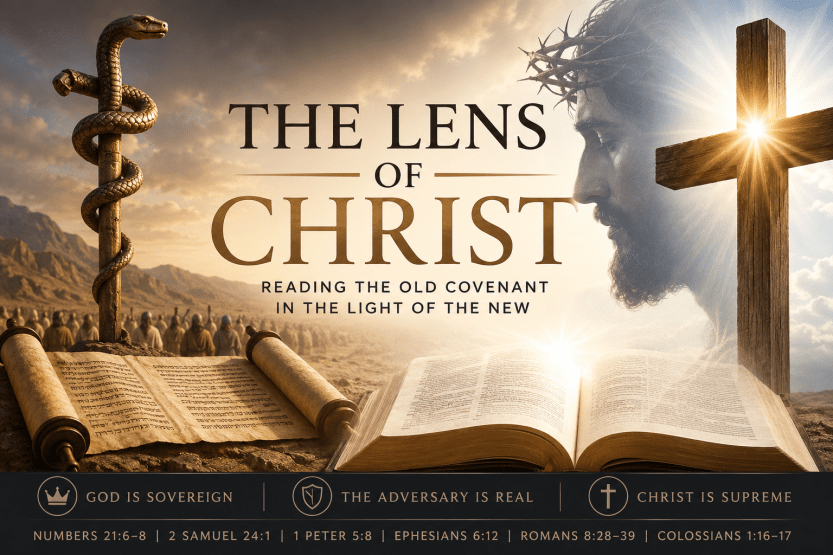
From this perspective, passages such as Numbers 21 can be approached with greater clarity. The text attributes the sending of the serpents to the Lord, as was common within the Old Covenant framework. Yet in the fuller light of Christ, we are invited to consider not only God’s sovereignty over the event, but also the broader spiritual realities that were not yet fully unveiled to those living before the revelation of Christ.
Most importantly, the passage points beyond itself to Jesus, who identified the bronze serpent lifted up in the wilderness as a prophetic picture of His own crucifixion. Even within a narrative marked by judgment, the central emphasis is God’s provision of redemption. The story ultimately directs our attention not to the serpents, but to the One who would be lifted up so that all who look to Him in faith might live.
The Lens of Christ: Reading the Old Covenant in the Light of the New.